Introduction: The Critical Need for Hospital Emergency Parking
Healthcare facilities, regional medical centers, and emergency trauma hubs operate under unique, life-critical logistical demands. When seconds count, doctors, emergency response medical teams, and urgent patients cannot afford to waste critical time searching for parking in congested surface lots.
In many urban hospitals, parking lots are severely overcrowded, resulting in blocked ambulance lanes, delayed shift transfers for medical specialists, and intense stress for patients’ families. Because hospitals must preserve open ground areas for ambulance access, green healing gardens, and building expansions, traditional surface parking lots are structurally inadequate. Implementing Smart Vertical Rotary Parking Systems allows medical centers to expand parking capacity vertically without compromising ground-level emergency access.
1. Expanding Medical Center Parking Density: 35 m² into 20 Vehicle Slots
Emergency centers require maximum parking consolidation as close to main triage and clinical entrances as possible. Traditional surface parking consumes approximately 17.5 m² per vehicle and forces visitors to walk across sprawling outdoor lots.
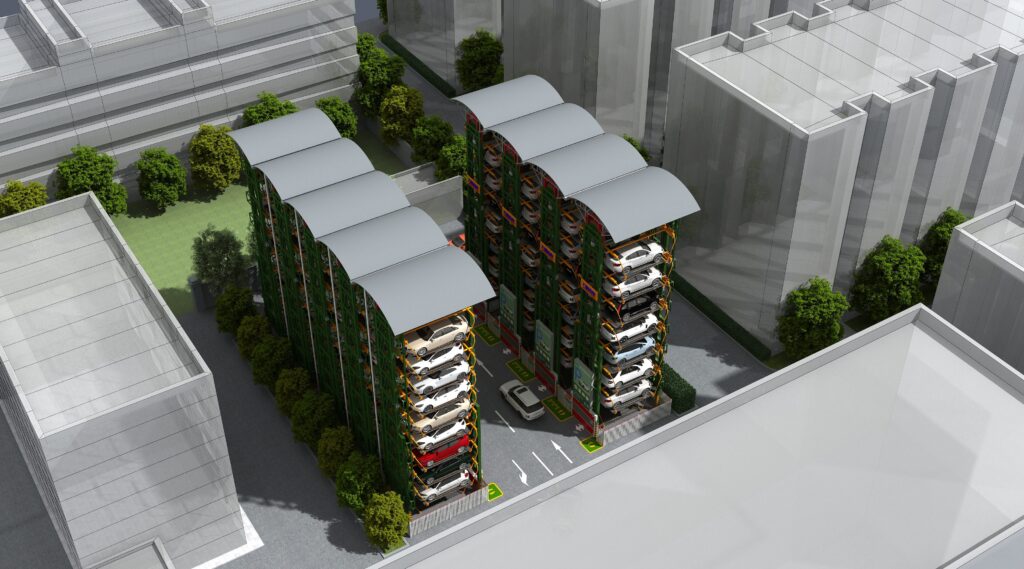
Operating on a compact footprint of roughly 35 m²—the space taken by just two surface parking slots—a Jiuroad vertical rotary unit extends upward across 6 to 12 tiers, housing between 12 and 20 vehicles (and up to 22 slots in high-density models).
| Hospital Layout Option | Footprint Area Required | Vehicle Storage Capacity | Density Expansion Gain |
| Standard Surface Lot | ~35 m² | 2 Vehicles | Baseline (1x) |
| Jiuroad Rotary System (6-12 Tiers) | ~35 m² | 12 to 20 Vehicles | 600% – 1000% Increase |
By converting underutilized courtyard corners or narrow spaces adjacent to clinical wings into vertical parking towers, hospital administrators can free up crucial ground land for emergency vehicle transit corridors.
2. Engineered for Healthcare Environments: Silent Drive & High Safety
Medical facilities carry strict acoustic regulations to maintain a restful environment for inpatient wards and intensive care units (ICUs).
Ultra-Quiet Performance (< 60 dB)
Industrial noise is unacceptable near hospital patient wards. Jiuroad vertical rotary systems feature precision-balanced drive mechanisms and vibration-dampening mounts that maintain operational noise strictly below 60 dB. The system operates smoothly and quietly, preserving a serene environment for healing.
Sedan and Heavy SUV Compatibility
Driven by powerful 7.5 kW to 30 kW motors, the system accommodates diverse vehicle types. Physicians, hospital staff, and patients can park compact sedans or full-size SUVs up to 12 tiers high without structural re-engineering.
3. Medical Staff Amenities: CHARPARKING EV Charging & Hands-Free Access
With healthcare workers often working long 8-to-12-hour shifts, offering reliable EV charging infrastructure improves employee satisfaction and supports green hospital initiatives.
CHARPARKING 7kW AC Slow Charging Integration
Jiuroad offers the integrated CHARPARKING 7kW AC Slow-Charging System:
- Shift-Long Charging: Doctors and nurses can plug in their electric vehicles at the start of their shift and receive a steady, safe 7kW AC charge across 8 to 12 hours.
- Safe Power Delivery: Steady AC charging prevents battery pack overheating and protects the hospital’s primary electrical grid.
Multi-Modal Access Control
- Facial Recognition: Registered surgeons and emergency physicians enjoy hands-free access to retrieve their vehicles rapidly after shifts.
- IC Card / Proximity Tap: Quick access for outpatient visitors and hospital administrative staff.
- Interactive Touchscreen Terminal: Multi-lingual instructions for visiting patients and family members.
4. Severe Safety Protections & Rapid 3-to-5 Day Installation
Safety safeguards must prevent mechanical failures near public pedestrian zones and active medical bays.
Redundant Safety Safeguards
- Hydraulic Chain-Break Brake System: Features a direct-acting hydraulic disc brake system delivering up to 100,000 N·m of holding torque, instant-locking the structure if abnormal tension occurs.
- Anti-Scratch & Anti-Sway Sensors: Optical sensors verify proper vehicle dimensions before movement, while anti-sway controls maintain balance during rotation.
- Manual Power-Outage Override: Guarantees that medical staff can safely retrieve vehicles during sudden hospital grid blackouts.
Rapid 3-to-5 Day Installation
Hospital operations cannot endure months of disruptive construction noise and dust. Jiuroad vertical rotary units feature a pre-engineered modular design:
- Fast Site Erection: Complete mechanical installation and commissioning are finished in just 3 to 5 days per unit.
- Minimal Civil Impact: Requires only basic concrete pad foundations, keeping main hospital thoroughfares open.
Conclusion & Medical Facility Upgrade Next Steps
By converting 35 m² of ground space into a 20-vehicle capacity vertical hub equipped with silent drive mechanics, CHARPARKING EV readiness, and robust safety mechanisms, medical centers can eliminate emergency parking bottlenecks.
Contact our healthcare infrastructure engineering team today to request a customized CAD layout and site analysis for your hospital.