Introduction: The Commuter Transit Bottleneck
Major transportation hubs—including international airports, high-speed railway terminals, metro interchange stations, and suburban Park & Ride (P+R) facilities—serve as the critical arteries of modern urban mobility. Thousands of commuters, business travelers, and long-distance passengers converge on these facilities daily, demanding seamless transitions between private vehicles and public transit networks.
However, as passenger throughput surges, transit hub parking infrastructure is facing unprecedented strain. Expansive horizontal surface parking lots spread over vast distances, forcing commuters to walk long distances to terminal entrances and aggravating traffic bottlenecks during peak rush hours. Furthermore, acquiring adjacent land near metropolitan transit terminals is often financially unfeasible or restricted by urban planning constraints.
To maintain efficient transit operations and satisfy modern commuter expectations, transportation authorities and private infrastructure developers are turning to Smart Vertical Rotary Parking Systems. By leveraging high-density vertical mechanical engineering, transit hubs can dramatically expand vehicle capacity, reduce terminal congestion, and integrate modern green infrastructure within a minimal ground footprint.
1. High-Density Spatial Consolidation: 35 m² into 20 Car Slots
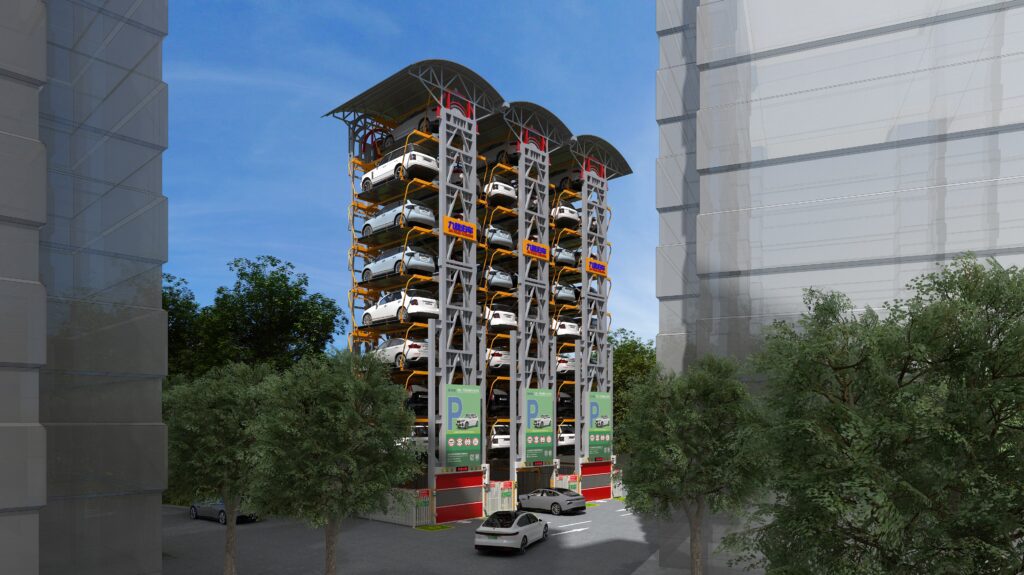
In major transit hubs, proximity to terminal gates and platform entrances is the single most valuable spatial factor. Standard surface parking structures require expansive access corridors, ramps, and individual driving lanes, yielding an inefficient footprint of approximately 17.5 m² per vehicle.
Smart vertical rotary parking equipment maximizes spatial density by utilizing vertical space. Operating on a compact ground footprint of approximately 35 m²—equivalent to just two standard surface parking bays—a vertical rotary tower extends upward across 6 to 12 structural tiers.
| Facility Parking Layout | Footprint Required | Vehicle Storage Capacity | Density Gain Multiplier |
| Standard Surface Lot | ~35 m² | 2 Vehicles | Baseline (1x) |
| Jiuroad Rotary System (6-12 Tiers) | ~35 m² | 12 to 20 Vehicles | 6x – 10x Density Expansion |
This spatial consolidation enables airport and railway operators to convert former dead zones—such as drop-off lane peripheries, structural setbacks, and underutilized plaza corners—into high-capacity parking banks housing between 12 and 20 vehicles per unit (and up to 22 slots in maximum-tier configurations).
2. Engineered for Heavy Transit Cycles: Heavy-Duty Transmission & Versatility
Transit hub parking systems operate under continuous, high-frequency conditions, accommodating diverse vehicle types ranging from compact commuter sedans to full-size family SUVs. Jiuroad systems are engineered specifically to handle continuous commercial duty cycles with maximum structural reliability.
Mixed Fleet Accommodation (Sedan & SUV Compatibility)
Unlike restrictive mechanical stackers, Jiuroad vertical rotary units feature heavy-duty cradles engineered to accommodate both standard sedans and heavy sports utility vehicles (SUVs) up to 12 tiers high. Drive motors ranging from 7.5 kW to 30 kW deliver smooth, reliable lifting torque across varying vehicle weight distributions.
Advanced DRMT Dual-Loop Drive Mechanics
- High Transmission Efficiency: Incorporates a proprietary DRMT dual-loop drive mechanism delivering 0.97 to 0.99 transmission efficiency, minimizing energy consumption during high-frequency rotation cycles.
- Lifetime Disk Warranty: The main gear disk is forged from high-durability alloy and includes a lifetime warranty, ensuring round-the-clock operational reliability for busy transit terminals.
All-Weather Heavy Structural Engineering
- Level 10 Wind Resistance: Reinforced structural steel trusses ensure operational integrity during severe outdoor coastal or airport apron winds.
- 8.0 Magnitude Seismic Rating: Built to withstand severe seismic shocks without structural deformation or cradle dislodgement.
3. Smart Terminal Integration & CHARPARKING EV Charging
Modern transit hubs rely on automated management systems to ensure fast vehicle drop-off and retrieval times, preventing roadway congestion during peak commuter hours.
Automated Multi-Modal Access Control
Jiuroad equipment features intuitive digital interfaces designed to accelerate transaction times to under two minutes per vehicle:
- Facial Recognition Terminals: Provides hands-free access for monthly commuters, airport staff, and rail crew members.
- IC Card / NFC Proximity Swiping: Integrates seamlessly with municipal transit cards, contactless bank cards, and digital P+R ticketing systems.
- Interactive Touchscreen Terminals: Offers clear visual instructions for multi-lingual international travelers and first-time visitors.
CHARPARKING 7kW AC Slow Charging Integration
As transit authorities transition toward zero-emission transportation goals, integrating EV charging into Park & Ride facilities is essential. Jiuroad offers the integrated CHARPARKING 7kW AC Slow-Charging System:
- Long-Term Park & Ride Charging: Travelers can park their electric vehicle, plug into the rotary cradle, and take high-speed rail or flights while their vehicle charges safely.
- Balanced Electrical Grid Load: The 7kW AC power rating provides reliable, steady charging suitable for long-duration stays without creating power surge spikes on transit facility power grids.
4. Redundant Safety Controls & Rapid Deployment (3 to 5 Days)
In high-volume public transit environments, safety and minimal operational downtime are paramount.
Multi-Layered Safety Engineering
- Hydraulic Chain-Break Protection: Features a direct-acting hydraulic disc brake system generating up to 100,000 N·m of braking torque, instant-locking the drive system in the event of abnormal mechanical tension.
- Anti-Sway & Laser Positioning: Optical sensors detect vehicle dimensions and wheel placement before movement, while anti-sway technology maintains steady vertical movement.
- Power-Outage Manual Retrieval: Includes a emergency manual override, ensuring travelers can always retrieve their vehicles on schedule even during grid power disruptions.
Fast 3-to-5 Day Installation
Constructing conventional concrete multi-story parking garages at busy airports or train stations creates years of traffic detours and construction noise. Jiuroad vertical rotary units utilize pre-assembled modular steel components:
- Erection Time: On-site installation and testing are completed in just 3 to 5 days per unit.
- Minimal Disruption: Requires only basic concrete pad foundations, keeping transit station roadways open throughout installation.
Conclusion & Infrastructure Call-To-Action
Smart vertical rotary parking systems deliver an immediate, highly scalable solution to parking congestion at transit hubs, airports, and Park & Ride terminals. By turning 35 m² of surface ground space into a 20-vehicle capacity vertical hub equipped with heavy-duty drive systems, EV charging, and robust safety mechanisms, transit authorities can modernize their infrastructure while enhancing commuter satisfaction.
Partner with Jiuroad for Transit Infrastructure Projects
Jiuroad provides complete engineering consultation, CAD layout integration, structural feasibility analysis, and customized ROI models for municipal transit projects.
Contact our infrastructure engineering specialists today to request a customized CAD layout and site analysis for your transit hub facility.